
Introduction
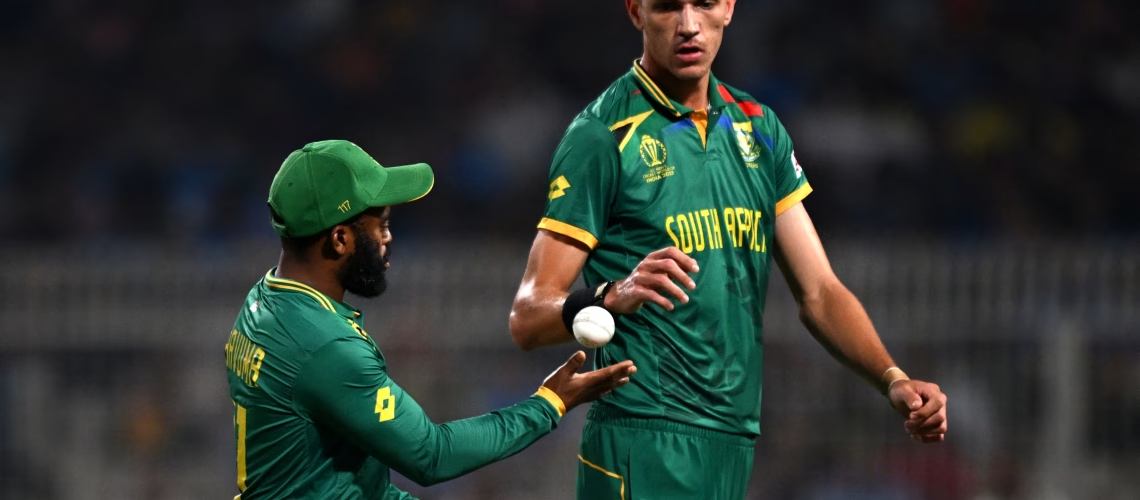
South Africa’s fast-bowling resources have been significantly depleted with Kwena Maphaka ruled out due to a right hamstring strain. He becomes the fourth frontline fast bowler unavailable for the Australia ODI series.
Maphaka joined Kagiso Rabada, Lungi Ngidi, and Ottneil Baartman on the injury list, all suffering hamstring-related problems. Nandre Burger’s back injury creates an additional absence, leaving the Proteas without five crucial seam-bowling options.
For winplay cricket enthusiasts following the Proteas, this injury crisis represents a substantial competitive disadvantage. Cricket South Africa called up experienced Lizaad Williams as Maphaka’s replacement while relying on developing alternatives.
Key Takeaways
- Kwena Maphaka ruled out with right hamstring strain shortly before Australia ODI series
- Kagiso Rabada, Lungi Ngidi, Ottneil Baartman, and Nandre Burger all unavailable through injury
- All four primary fast bowlers affected by hamstring or back problems
- Lizaad Williams called up as Maphaka replacement with significant international experience
- Duan Jansen selected for Baartman while 20-year-old Nqobani Mokoena replaces Ngidi
- Six available seamers possess a combined 72 ODI caps — far less than the frontline attack
- South Africa managed the first ODI through spin-bowling and all-round depth
Understanding the Scope of South Africa’s Bowling Crisis
The simultaneous unavailability of multiple frontline fast bowlers represents a crisis of substantial proportions. It impacts entire team strategy and selection philosophy rather than just individual roles.
Losing four established international fast bowlers within similar timeframes creates cascading tactical challenges. South Africa’s situation demonstrates how modern cricket’s demanding schedules compound injury risks across player populations.
For winplay cricket observers analyzing Proteas prospects, this represents genuine concern regarding long-term player development. The 2027 World Cup cycle approaches, and sustainable fast-bowling development becomes crucial for championship teams.
Hamstring Injuries and Workload Management Patterns
The prevalence of hamstring injuries across South Africa’s fast-bowling group suggests potential workload management concerns. Modern cricket’s fixture congestion creates demands extending beyond traditional international schedules.
Players balancing multiple cricket commitments often face injury susceptibility when recovery proves insufficient. This pattern requires coaching staff attention and individual player conditioning review.
Replacement Personnel and Experience Gaps
Cricket South Africa’s selection of experienced Lizaad Williams provides reassuring continuity through an established international performer. However, Williams cannot fully compensate for Maphaka’s potential contributions to squad development.
The broader replacement group, including Jansen and Mokoena, represents necessary alternatives yet highlights experience gaps. These gaps exist between established performers and developing options.
For winplay cricket followers evaluating squad capability, the combined 72 ODI caps represents substantially lower experience. This deficit matters particularly when competing against experienced opposition like Australia.
Williams’ Experience and Pressure Management
Lizaad Williams brings international experience and established performance credentials. These partially offset the broader group’s inexperience during high-intensity competition.
However, expecting a backup seamer to establish comprehensive attack quality equivalent to frontline options is unrealistic. Williams’ primary value involves providing stability and experienced decision-making.
Mokoena’s Development Opportunity and Challenge
Selecting 20-year-old Nqobani Mokoena as Ngidi’s replacement provides development opportunity while creating pressure exposure. Young fast bowlers develop through graduated exposure to international cricket pressure.
Thrusting a young bowler prematurely into high-stakes competition can create psychological challenges. Cricket South Africa must balance selection necessity with player development responsibility.
Temba Bavuma’s Leadership Challenge and Tactical Adaptation
Proteas captain Temba Bavuma faces the demanding responsibility of leading a team with significant bowling constraints. He must maintain competitive standards against quality opposition despite reduced resources.
Bavuma’s prior acknowledgment of the challenge confirms that coaching staff understand the seriousness. This crisis demands fundamental tactical adaptation extending throughout the entire series.
For winplay cricket observers assessing leadership capability, Bavuma’s performance will provide substantial insight. Leaders maintaining competitiveness despite resource disadvantages typically emerge with enhanced reputations.
Spin-Bowling Reliance and Tactical Shift
South Africa’s successful opening ODI demonstrated that effective spin-bowling can partially compensate for reduced pace. Keshav Maharaj and Bjorn Fortuin’s contribution established that outcome depends upon bowling quality rather than quantity.
However, sustainable reliance upon spin-bowling dominance represents risky strategy across multiple venues. Conditions vary significantly between grounds, creating tactical uncertainty.
The Wanderers venue in Johannesburg typically provides faster, bouncier pitches favoring pace bowling. South Africa’s tactical approach must adapt to venue-specific conditions while compensating for reduced pace options.
Long-Term Season Concerns and 2027 World Cup Preparation
Beyond the Australia series, South Africa faces a demanding home schedule including Bangladesh and England series plus Test cricket. Concurrent bowling constraints across both formats compound challenges in managing personnel.
Sustaining competitive performance while managing injury recovery demands sophisticated squad management. Player wellness programs become essential for navigating extended fixture congestion.
For winplay observers monitoring Proteas development toward 2027, this situation highlights the importance of sustainable bowling systems. Championship programs require production pipelines ensuring continuous quality replacement options.
Conclusion
South Africa’s fast-bowling crisis represents a substantial competitive challenge requiring tactical adaptation. The successful opening ODI demonstrated that effective spin-bowling and all-round contributions can partially compensate for reduced pace options.
For winplay cricket enthusiasts monitoring Proteas progress, this situation represents a crucial test of squad depth. Maintaining competitive standards despite constraints would validate South Africa’s development programs and 2027 World Cup preparation.
Frequently Asked Questions
How many Proteas fast bowlers are currently injured?
Five significant seam bowlers are unavailable: Kagiso Rabada, Lungi Ngidi, Ottneil Baartman, Kwena Maphaka (hamstring), and Nandre Burger (back). This represents substantial bowling depletion.
Who replaced Kwena Maphaka?
Experienced seamer Lizaad Williams was called up as Maphaka’s replacement. Williams brings international experience to help bolster the depleted bowling attack.
What is the experience level of South Africa’s available seamers?
The six available seamers possess a combined 72 ODI caps, substantially lower than typical international attacks. This limited experience requires careful management against Australia.
How old is Nqobani Mokoena?
Nqobani Mokoena is 20 years old and selected as Lungi Ngidi’s replacement. His selection provides development opportunity while creating pressure from high-stakes exposure.
Did South Africa manage the bowling crisis effectively in the first ODI?
Yes, South Africa won the opening ODI by 67 runs. They adapted successfully through spin-bowling excellence, batting depth, and all-round contributions.
Which venue hosts the second Australia ODI?
The second ODI is scheduled for the Wanderers in Johannesburg on 27 September. This venue typically favors pace bowling, potentially complicating South Africa’s approach.
What impact might this bowling crisis have on the 2027 World Cup?
The injuries highlight the importance of sustainable bowling development systems. South Africa must develop replacement options capable of competing at international standards.
Important Information
DISCLAIMER: This article contains cricket news, analysis, and commentary for informational purposes. Sports outcomes are unpredictable. Any predictions or analysis are based on historical data and expert opinion but do not guarantee specific results. If you engage in sports betting through platforms like winplay, please bet responsibly and within your means. Always review the terms and conditions of your betting platform and ensure compliance with local regulations. This content is not financial or betting advice.
Cited Sources
- Cricket South Africa — Official injury updates and squad announcements
- ESPNcricinfo — Proteas bowling news and injury coverage
- International Cricket Council — Player records and squad information
- SuperSport Cricket — Team news and captain commentary
- Cricbuzz — Experience metrics and bowling statistics